
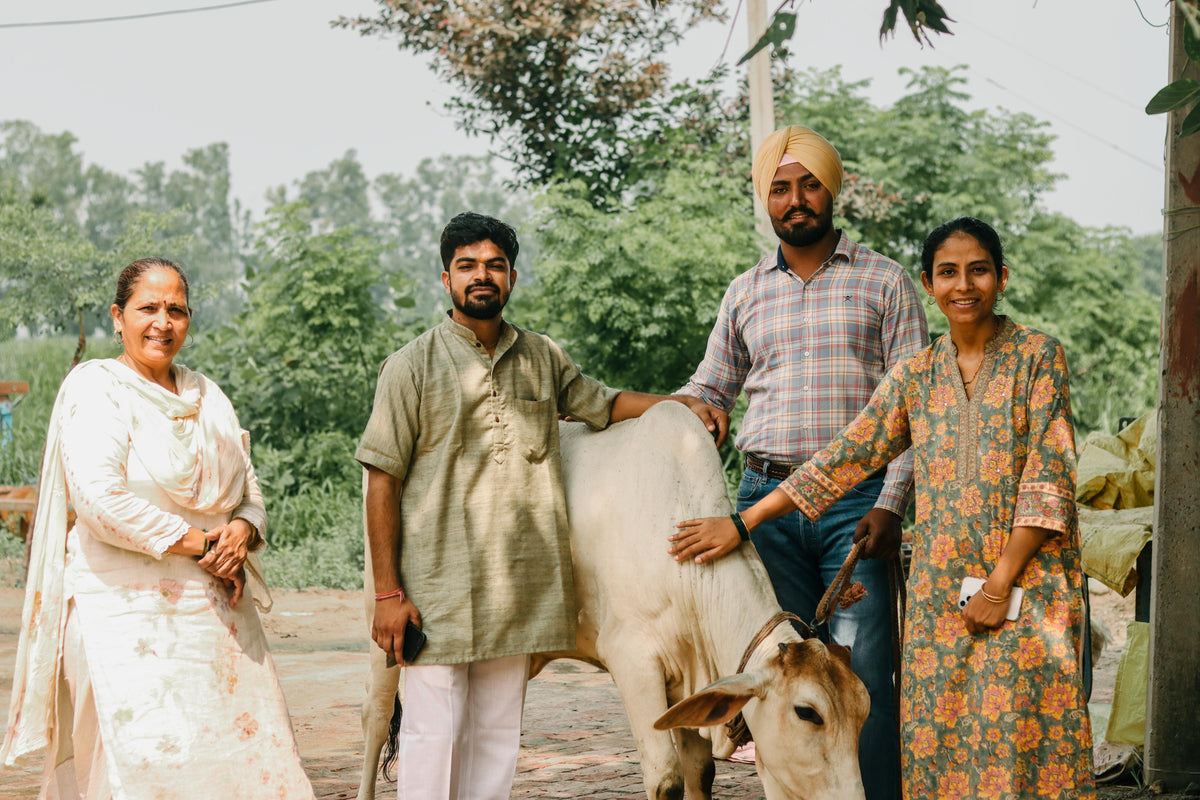
When a breed has value, there is a reason to keep raising it.
India's indigenous cattle are part of our agricultural heritage, but heritage alone will not keep them. Farmers need viable reasons to go on raising them.
So we start somewhere practical: real demand for named breeds.
From recognition to relevance.
Our impact begins by putting the breed back into the conversation. Instead of an anonymous “desi cow”, we name the animal behind the product. Instead of an anonymous supply chain, we help people find its region, its farmer and its farming system.
Because what people recognise, they are more likely to value.
- Name the breed
- Tell its story
- Create demand
- Support livelihoods
- Keep the ecosystem relevant
Each step only works if the one before it did. This is the whole theory of the business, written out.
Give the breed its name back.
Gir should be Gir. Kankrej should be Kankrej. Sahiwal should be Sahiwal. Tharparkar should be Tharparkar.
India's indigenous cattle are not one generic category. Each breed carries its own history, geography and characteristics, and collapsing them into a single label is how that diversity quietly stops being counted.
The first step toward protecting it is simpler than it sounds: make it visible.
The breed deserves its name on the jar.
Conservation needs an economy.
A farmer cannot keep raising an indigenous breed only because the breed is culturally important. The ecosystem has to support a livelihood as well as a heritage.
Our aim is to build real consumer demand for products tied to specific native breeds. As that demand grows, so does the economic case for continuing to raise them.
Not charity. Not nostalgia. A functioning market.
Make the farmer visible too.
Behind every indigenous breed are people who still raise it, understand it and care for it. How animals are selected, fed, kept and worked into a farming system is itself part of India's agricultural heritage, and it is held by people rather than written down.
As we grow, we want every breed story to connect back to the farmers and breeders, the farms, the gaushalas where they are involved, the local communities, and the regional food makers who work alongside them.
Breed. Farmer. Farm. Region. Not an anonymous supply chain.
Protect the circle around the cow.
The indigenous cow was historically part of a much larger system. The animal supported the farm, farm waste fed the soil, fields grew crops and fodder, and the farmer produced food. Very little of it stood on its own.
As our wider farm work develops, we want to bring those relationships back into view: cattle integrated into the farm rather than parked beside it, composting, soil that is rebuilt rather than spent, and diversified cropping.
The Indian farm was designed as a circle, not a factory.
- Cow
- Manure
- Soil
- Crop
- Fodder
- Farmer
- Food
What we know, we are more likely to value.
Breed conservation is not only about animals. It is also about memory: the names of the breeds, the landscapes they come from, the people who raise them, the work they historically did, and the food traditions built around them.
We want that knowledge to be findable by a generation that did not grow up next to it.
A living map of India's native cattle.
India holds many distinct cattle ecosystems, each shaped by its own land, weather and working needs. As we grow, every breed we work with becomes another entry, a living archive of the breeds, farms, people and landscapes we are connected to.
- GirSaurashtra, Gujarat
- KankrejBanaskantha & the Rann, Gujarat–Rajasthan
- SahiwalThe Punjab plainsBreed story coming
- RathiBikaner, RajasthanBreed story coming
- TharparkarThe Thar, RajasthanBreed story coming
- HarianaHaryanaBreed story coming
- BadriThe Uttarakhand hillsBreed story coming
- HallikarThe Deccan, KarnatakaBreed story coming
- KhillarThe Deccan, Maharashtra–KarnatakaBreed story coming
Regions are indicative. Breed ranges overlap and shift, and we would rather be approximately honest than precisely wrong.
Our impact, as it grows.
Most of these are blank, and they will stay blank until they are real. We would rather publish an empty number than a flattering one.
- 2
- Indigenous breeds represented Gir and Kankrej, with more in the roadmap
- Not yet published
- Farmers and breeders partnered
- Not yet published
- Indigenous cattle connected
- Not yet published
- Regions represented
- Not yet published
- Breed-specific products launched
- Not yet published
- Acres connected to our ecosystem
Impact should be measured, not manufactured. These figures will fill in as the farmer and breed network grows, and each will carry the date it was current as of.
From products to ecosystems.
Ghee is the starting point, not the ambition. The larger aim is an ecosystem in which indigenous breeds, farmers, traditional foods and responsible agriculture each make the others more viable.
Today
Gir and Kankrej breed-specific ghee.
Next
More indigenous breed stories, and the breeds that will never be a jar.
Then
Farmers, farms and native agriculture, named.
Future
A connected farm ecosystem rather than a supply chain.
Long term
Food, breeds, agriculture, experiences and knowledge, holding each other up.
Help make native breeds relevant again.
Every time someone asks which breed, where it came from and who raised it, the food system gets a little harder to be vague in. That question is the whole mechanism.